Death by a Thousand Fees: Why It Feels Impossible to Get Ahead in NJ
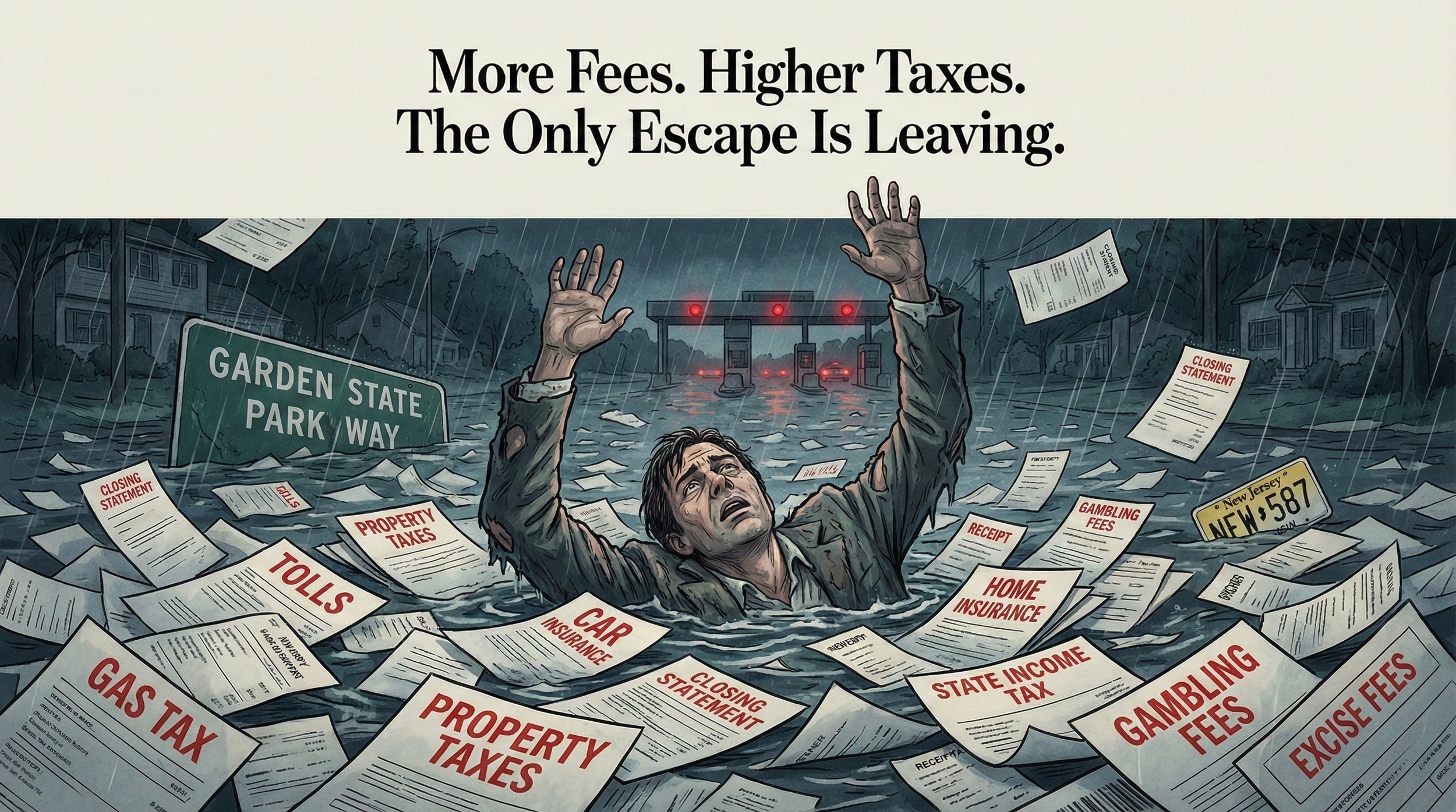
It’s not just the property taxes—it’s the endless flood of smaller fees that finally pulls you under.
If you live in New Jersey, congratulations. You already reside in one of the highest-taxed states in America, and according to the latest state migration data from United Van Lines, New Jersey continues to rank among the states people are leaving most often. Income taxes creep up faster than salaries. Gas taxes make every fill-up feel personal. Tolls somehow never go away. So naturally, heading into 2026, the state looked at all of this and said, “You know what this needs? More.”
More taxes.
More fees.
More tolls.
More creative ways to separate you from your paycheck without technically calling it a tax.
Below is a clear, no-spin breakdown of the new and increased taxes and fees New Jersey residents will feel in 2026, what each one actually is, and what it realistically costs you.
Gas Taxes Go Up Again
As of January 1, 2026, New Jersey’s gas tax increased by roughly 4.2 cents per gallon. The total state tax burden on gasoline now sits at about 49 cents per gallon, with diesel even higher.
This increase is tied to the Transportation Trust Fund, which is supposed to fund roads, bridges, and infrastructure. On paper, that sounds reasonable. In reality, New Jersey drivers already pay some of the highest fuel taxes in the country.
What this costs you:
If you drive about 12,000 miles per year and average 25 miles per gallon, that’s roughly 480 gallons annually. An extra 4.2 cents per gallon equals about $20 more per year. That number sounds small until you remember gas taxes never go down and higher transportation costs quietly raise the price of everything else you buy.
Garden State Parkway Tolls, Still Not Temporary
Here’s a classic New Jersey memory. Parkway tolls were originally sold to the public as temporary, meant to fund construction and maintenance. Once paid off, the tolls were supposed to disappear.
If you laughed, you’ve lived here long enough.
In 2026, tolls on the Garden State Parkway and New Jersey Turnpike increased again, roughly 3 percent. These increases are now treated as routine, like roadwork cones that never leave.
What this costs you:
For daily commuters, especially those using the Parkway regularly, toll increases can easily add $100 to $300 per year, sometimes more. There is no deduction, no rebate, and no sunset clause. Just higher tolls on roads that still somehow need fixing.
“No Tax on Tips” and “No Tax on Overtime,” Federal Relief Only
You may have seen headlines or campaign talking points about eliminating taxes on tips or overtime pay. Here’s the fine print that matters in New Jersey. Any relief passed applies only to federal income taxes, not New Jersey state taxes. At the state level, tips and overtime are still treated exactly the same as regular wages and remain fully taxable in 2026. New Jersey did consider a proposal to exempt tips from state income tax, but it failed to pass before the legislative session ended. No similar exemption was ever enacted for overtime pay at the state level.
What this costs you:
If you earn an extra $10,000 per year in overtime or tipped income, New Jersey still taxes every dollar at your full marginal rate. Even if federal withholding drops slightly, the state continues to take its share, unchanged, while new fees and consumption taxes keep piling up.
The Mansion Tax Expansion, Even If You’re Not “Rich”
New Jersey expanded its so-called mansion tax, which applies to property sales over $1 million, with steeper tiers beginning at $2 million and above. Rates now range from 1 percent to as high as 3.5 percent, applied to the entire sale price, not just the amount over the threshold. In many cases, the tax burden has shifted to the seller, not the buyer.
What this costs you:
Selling a $2 million home can now trigger a tax bill of roughly $40,000. At $3 million, that number can exceed $100,000. In New Jersey, this does not just affect luxury estates. It hits longtime homeowners, inherited properties, small investors, and families downsizing after decades in the same house.
Marijuana Taxes, Higher Prices Without Relief Anywhere Else
New Jersey increased taxes and excise fees on legalized marijuana with the pitch that it would generate meaningful public revenue, but that money does not go toward lowering everyday costs for residents. Cannabis tax dollars flow into the state’s general fund and are earmarked largely for social programs, regulatory expenses, and administrative overhead. For consumers, the result is simple. Higher prices at dispensaries, fewer competitive options compared to neighboring states, and no relief elsewhere in the household budget. The state gets reliable revenue. Residents just pay more for something that was supposed to be cheaper once legalized.
Gambling and Sports Betting, Big Revenue Headlines, Small Household Impact
New Jersey also raised taxes on online gambling and sports betting, pushing effective rates close to 20 percent, but this revenue is primarily used to support the broader state budget and offset existing obligations like pensions and healthcare costs. It does not flow back to residents in a way that reduces their cost of living. While gambling tax collections make for impressive headlines, they are small relative to the overall tax burden and are absorbed into ongoing spending. Bettors see worse odds and lower payouts, and households see no offsetting benefit.
Firearm and Ammunition Fees
New Jersey added or expanded excise fees on firearms and ammunition, framed as public safety measures.
What this costs you:
Legal gun owners face higher purchase prices and higher recurring costs, especially for training and ammunition. These increases add up quickly and place New Jersey among the most expensive states for lawful ownership.
Drone Fees, Because Apparently That’s a Thing Now
Yes, drones.
New Jersey introduced an excise tax on certain unmanned aerial vehicles, affecting commercial users and higher-end recreational drones.
What this costs you:
Hobbyists, photographers, and small businesses may see tens to hundreds of dollars in additional costs depending on equipment. It’s not a massive burden on its own, but it perfectly illustrates how aggressively the state searches for new taxable categories.
The Big Picture, Death by a Thousand Fees
None of these increases alone forces most people to leave. That’s the point.
New Jersey’s tax structure works through accumulation. A little more at the pump. A little more at the toll booth. A little more when you sell property. A little more in everyday purchases. Eventually, people do the math and start asking uncomfortable questions.
Final Thought
New Jersey residents are not imagining things. The state is expensive because policy after policy prioritizes revenue over affordability. 2026 does not bring relief. It brings more layers, more fees, and more pressure on household budgets.
If you feel squeezed, it’s not because you’re bad with money. It’s because you live in New Jersey.
Thinking About Escaping New Jersey?
If rising taxes, constant fees, and an ever-increasing cost of living have you questioning how long staying in New Jersey makes sense, you’re not alone. Every year, more residents run the numbers and realize the only real way to lower their cost of living is to leave.
EscapeFromNewJersey.com exists to help you do that intelligently. Whether you’re just starting to explore where you could move, want to understand what your New Jersey home might be worth, or need a clear path to selling and relocating without chaos, this is where that process begins.
Start by exploring your options. The math matters. Your quality of life does too. Contact us today.
